Heat-pump washer-dryers:
wash and dry on minimal electricity
Instead of heating the drying air electrically, a heat-pump washer-dryer uses a compression refrigeration circuit – like a fridge, only the other way round. That halves power consumption and dries laundry at low temperatures. Here in the test: the two appliances currently available on Amazon.
Both heat-pump washer-dryers on Amazon
Currently AEG and LG are the only manufacturers listing heat-pump washer-dryers on Amazon.de – 10 further condenser appliances can be found here.
 C
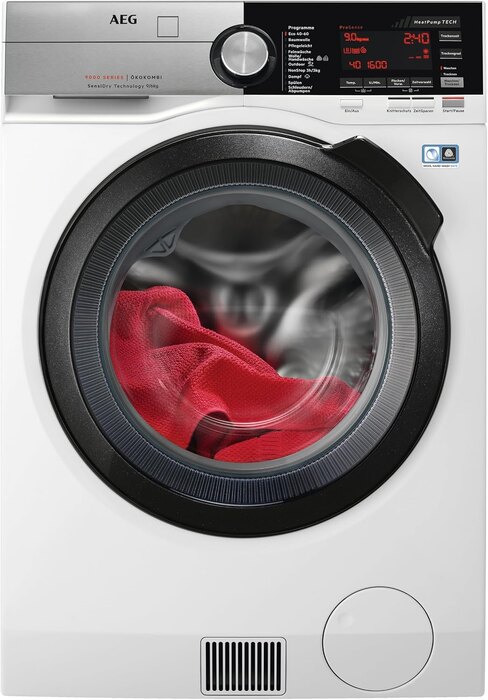
AEG L9WEF80690 Serie 9000
Heat-pump washer-dryer with 9/6 kg, SensiDry and ProSteam – the test winner at Stiftung Warentest (11/2025, score 2.0).
- True heat-pump technology: only 252 kWh per 100 cycles
- SensiDry dries at low temperatures – gentle on fabrics
- NonStop programme: 3 kg washed and dried in about 3 hours
ca. 690 €
 A
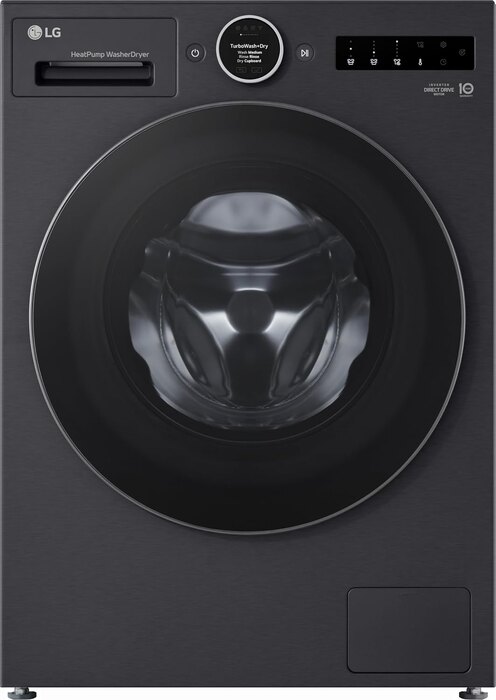
LG HPWD116BA X-Serie
LG’s X-Series heat-pump washer-dryer: 11/6 kg, energy class A/A and only 153 kWh per 100 cycles – the most efficient 2-in-1 on Amazon.
- Energy class A/A – the most efficient washer-dryer on Amazon
- Only 153 kWh per 100 cycles and 53 l of water
- AI Wash & Dry, ezDispense and ThinQ app
ca. 1.550 €
AEG L9WEF80690 vs. LG HPWD116BA
| Model | Capacity W/D | Class W / W+D | kWh/100 cycles | Spin | Price (guide) | Rating |
|---|---|---|---|---|---|---|
| AEG AEG L9WEF80690 Serie 9000 |
9.0 / 6.0 kg | A / C | 252 kWh | 1600 rpm | ca. 690 € | ★★★★★ |
| LG LG HPWD116BA X-Serie |
11.0 / 6.0 kg | A / A | 153 kWh | 1350 rpm | ca. 1.550 € | ★★★★★ |
How does a heat-pump washer-dryer dry?
A classic condenser dryer generates its drying heat with an electric heating element – simple, but power-hungry. A heat-pump appliance does it differently: a refrigerant circuit (evaporator, compressor, condenser) moves heat from the room air into the drum and recovers most of the energy instead of constantly generating it anew.
The result is visible in the EU data sheets: the LG HPWD116BA uses 153 kWh per 100 cycles, the AEG L9WEF80690 252 kWh – good condenser appliances sit at 305–370 kWh. At €0.30 per kWh, a heat-pump washer-dryer saves around €15–46 in electricity over 100 cycles compared with a Bosch Serie 8 appliance.
The second advantage: heat-pump washer-dryers work at significantly lower air temperatures. AEG’s SensiDry dries at temperatures low enough that even wool and silk are treated more gently than in many normal dryers.
Advantages of the heat pump
40–50 % less electricity than condenser appliances, gentle drying temperatures (SensiDry), better energy classes (LG: A/A) – and often less water in the W+D cycle too (AEG: 50 l).
Disadvantages
Higher purchase price (€690–1,550), longer programme times, a smaller model range, sometimes short availability – the LG HPWD116BA is often stocked only in small quantities.
Who is it worth it for?
For frequent dryers with little space: anyone running several W+D cycles per week recovers the surcharge through the electricity bill. At 2 cycles/week that takes around 4–6 years with the AEG and about 3–5 years with the LG.